

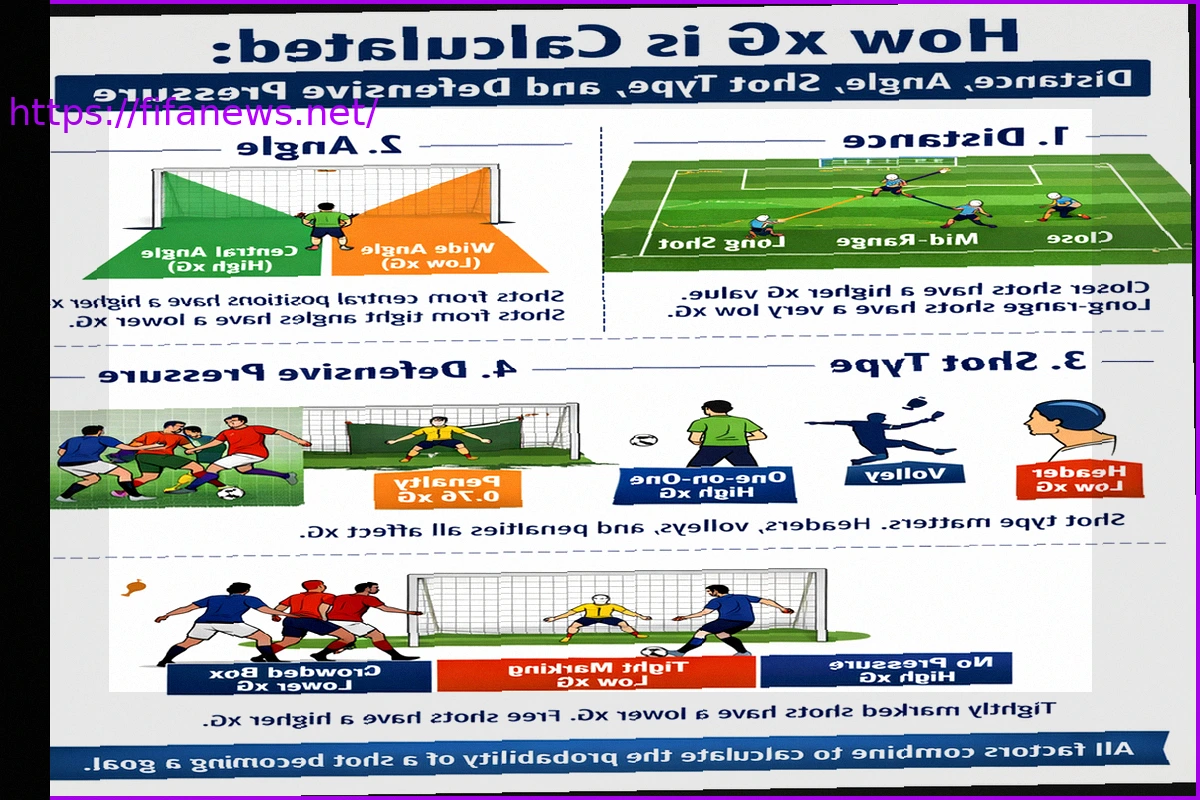
In contemporary football, statistics have evolved beyond simple numerical figures, now serving as sophisticated instruments for in-depth game analysis. Among these, Expected Goals (xG) stands out as a revolutionary metric that has fundamentally altered how analysts, coaches, and supporters evaluate offensive output. Unlike conventional goal tallies, xG quantifies the inherent quality of scoring opportunities generated by a team or individual, thereby offering a more comprehensive insight into performance. But what principles underpin its calculation? We will delve into the primary elements: the distance from goal, the shot’s angle, the specific type of shot, and the influence of defensive pressure.
What is Expected Goals (xG)?
Fundamentally, xG quantifies the probability that a particular shot will culminate in a goal. Each attempt at goal is assigned a numerical value ranging from 0 to 1, where 0 signifies an improbable chance and 1 denotes a near-certain goal. For instance, a penalty kick typically registers an xG value between 0.76 and 0.80, underscoring its high likelihood of success, whereas a speculative strike from outside the penalty area might only carry an xG of 0.02. By aggregating a team’s xG over a game or an entire season, one can discern whether they consistently fashion prime scoring opportunities or are merely benefiting from good fortune.
1. Distance from Goal
A primary determinant in xG calculation is the distance a player is from the target. Logically, closer proximity to the goal significantly increases the probability of scoring. Attempts originating within the six-yard box inherently possess a greater chance of success than shots launched from 25 or 30 yards away.
Sophisticated xG algorithms extend beyond simple linear distance, frequently integrating variables such as goalkeeper’s position and the attacker’s approach angle. For example, a shot from 12 yards with the goalkeeper slightly displaced presents a greater threat than an identical attempt where the keeper is perfectly positioned. Distance serves as a cornerstone variable in virtually every xG framework due to its direct correlation with scoring likelihood.
2. Angle to Goal
The angle relative to the goal mouth represents another crucial element. Shots struck from acute angles close to the goal line typically yield lower scoring probabilities compared to centrally positioned shots, even if the absolute distance is comparable. This phenomenon occurs because the net’s visible area from a tight angle is diminished, thereby enhancing the goalkeeper’s opportunity to intervene.
Certain xG methodologies employ the concept of a shooting corridor, which concurrently assesses both angle and distance. To illustrate, a shot from 15 yards directly in front of goal will have a substantially higher xG than a shot taken from 15 yards at a severe angle near the touchline. By integrating the angle, analysts can effectively distinguish between seemingly similar scoring opportunities that possess markedly different success rates.
3. Shot Type
The nature of the shot itself plays a significant role, as not all attempts are equally potent. Whether it’s a header, a volley, a simple tap-in, or a powerful long-distance strike, the shot type profoundly impacts its assigned xG value.
- Generally, headers register lower xG values than shots taken with the feet, even from close proximity, largely due to the inherent difficulty in precisely directing headers.
- Tap-ins, particularly those directly in front of the goal, frequently boast an xG exceeding 0.7, indicative of their very high scoring probability.
- Conversely, long-range shots from outside the box are typically associated with much lower xG figures, often below 0.05, unless they capitalize on a goalkeeper error or demonstrate extraordinary technique.
Furthermore, the player’s body orientation and ball control are also factored into the shot type assessment, as these elements directly affect the potential for a goal. Modern tracking systems can even discern if a shot was taken from a controlled stance or while a player was in motion, thereby enhancing the precision of xG computations.
4. Defensive Pressure
A vital, yet frequently understated, component of xG modeling is defensive pressure. Even an attempt from close range can become challenging if the shooter is closely guarded or subject to immediate opposition interference. Contemporary xG frameworks integrate variables such as the mere presence of defenders, the proximity of the closest opponent, and whether the attacker is contending with a congested penalty area.
For instance, a shot originating from within the box where a defender is actively sliding to block could witness its xG value decrease significantly, perhaps from 0.6 to 0.3. Conversely, an attempt from a seemingly crowded area but where the shooter finds unexpected space might retain a higher xG. By incorporating the defensive context, xG offers a more accurate portrayal of a scoring opportunity’s true quality, extending beyond its mere geographical location.
Additional Factors in xG Models
Beyond the primary considerations of distance, angle, shot type, and defensive pressure, certain advanced xG algorithms also factor in other parameters:
- Assist Type: Differentiating between chances created from through balls, crosses, or dead-ball situations.
- Body Part Used: Specifying whether the shot was taken with the right foot, left foot, or head.
- Game State: Distinguishing between opportunities arising from open play versus those from set pieces.
- Contextual Elements: Less frequently, factors like player fatigue or overall match tempo might be considered.
The inclusion of these supplementary variables contributes to a more sophisticated comprehension of scoring chance quality, furnishing coaches and analysts with enhanced insights into team and individual performance.
The Significance of Expected Goals (xG)
xG empowers football clubs to assess performance beyond merely the final scoreline. A team might, for example, suffer a 2-1 defeat yet record an xG of 3.0, suggesting they generated a sufficient volume of high-quality opportunities that, on average, should have translated into a victory. Conversely, a side winning 1-0 with an xG of only 0.5 could be deemed fortunate in their outcome. When analyzed over the course of a season, xG proves to be a superior predictor of future performance trends compared to simple goal counts, thus assisting clubs in making informed strategic choices regarding tactical approaches, player recruitment, and talent development.
Conclusion
Expected Goals has fundamentally transformed the landscape of football analysis, offering a rigorous, data-driven methodology for quantifying offensive quality. By meticulously incorporating elements such as the distance to goal, the angle of the shot, the specific type of attempt, and the intensity of defensive pressure, xG models distill intricate match scenarios into a readily comprehensible numerical value. Although xG is not infallible and should always be considered in conjunction with other performance indicators, it nonetheless serves as an invaluable asset for managers, data analysts, and supporters seeking to grasp the underlying dynamics of goal-scoring opportunities.
With ongoing advancements in tracking technologies, xG models continue to evolve, providing ever more profound insights into individual player effectiveness, strategic team formulations, and even prospective transfer acquisitions. For enthusiasts and professionals dedicated to football analytics, a clear understanding of the principles behind xG calculation is indispensable for a deeper appreciation of the beautiful game’s intricate nuances.