

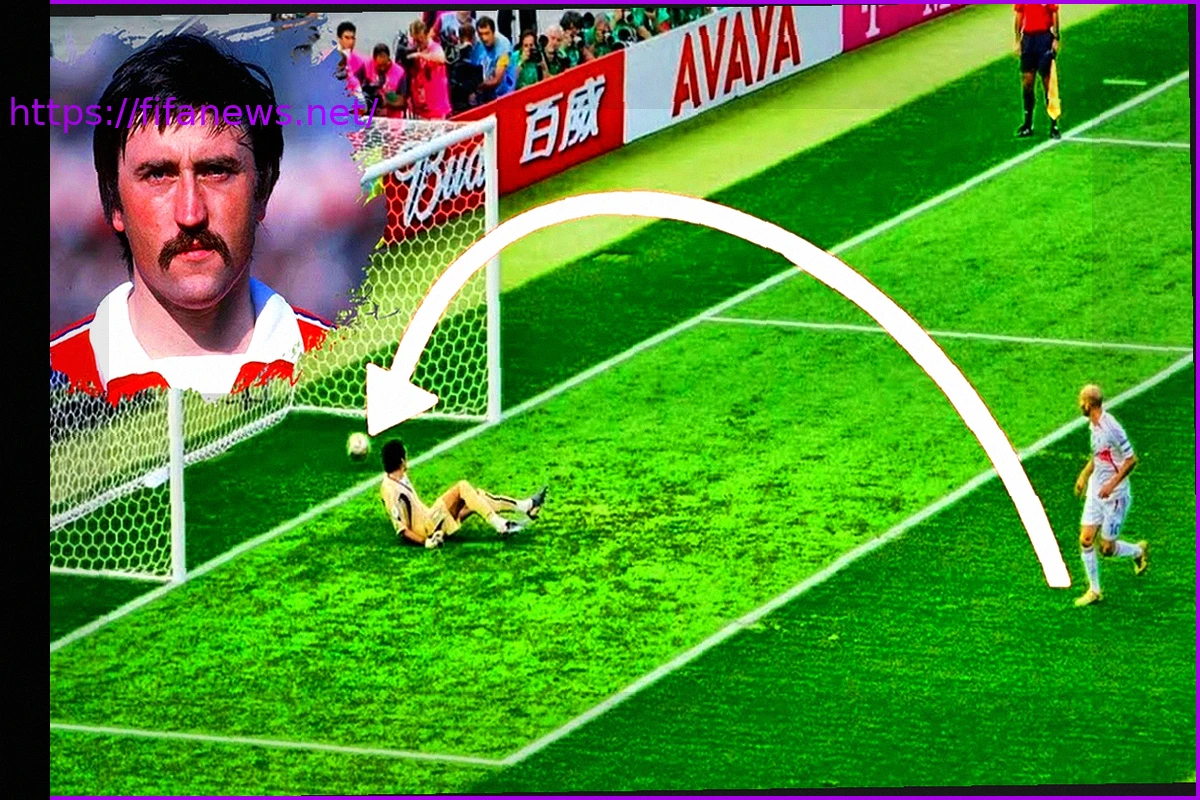
In football, few spectacles combine sheer audacity with elegant execution quite like the Panenka penalty. It’s a blend of precise technique, deep psychological understanding, and a touch of dramatic flair. When successfully pulled off, it has the power to both mortify the goalkeeper and ignite the crowd. However, a misjudged attempt can lead to severe embarrassment and crucial consequences. This article will delve into what defines a Panenka, its fascinating origins, and its notable appearances in the Premier League.
The Origins of the Panenka
The distinctive Panenka penalty is named after its inventor, Antonín Panenka, who unveiled this revolutionary technique during the dramatic UEFA European Championship Final of 1976. Representing Czechoslovakia in a nail-biting penalty shootout against West Germany, Panenka approached the spot with remarkable composure. Instead of striking the ball with power towards a corner, he opted for a delicate chip straight down the centre as legendary goalkeeper Sepp Maier committed to a dive. The ball gracefully sailed into the net, securing a historic victory and cementing its place as an unforgettable moment in football lore.
This audacious move wasn’t a spur-of-the-moment decision; Panenka had reportedly dedicated extensive time in training to perfect penalties, observing how goalkeepers often anticipated a forceful shot by diving early. His ingenious solution was to capitalize on this anticipation by maintaining calm and subtly lofting the ball centrally.
How the Panenka Works
Fundamentally, the Panenka is disarmingly straightforward. Rather than driving the ball with force, the player delicately chips it towards the very centre of the net. Its triumph hinges entirely on precise anticipation and unwavering composure.
The critical components for a successful Panenka include:
- Anticipating the Goalkeeper: Observing that most keepers commit by diving either left or right.
- Flawless Timing: Executing the chip with the precise amount of loft and power.
- Unshakeable Confidence: Any sign of hesitation almost invariably results in failure.
What truly sets this technique apart is its emphasis not on raw physical prowess, but on mental fortitude. The penalty taker essentially wagers on the goalkeeper’s decision to dive, fully committing to that calculated gamble.
Why Players Attempt a Panenka
The Panenka is widely regarded as the pinnacle of self-assurance in football. It possesses the capability to alter match momentum, undermine the morale of opposing teams, and galvanize one’s own teammates. Players opt for this high-risk, high-reward approach for several compelling reasons:
Psychological Superiority
By preying on a goalkeeper’s natural inclination to dive, the penalty taker gains a distinct mental advantage. As former Chelsea and Arsenal custodian Petr Cech articulated, goalkeepers frequently feel compelled to move rather than remain static, leaving them susceptible.
Surprise Factor
Given its relative infrequency, a Panenka can unexpectedly catch even the most seasoned goalkeepers off guard.
Dramatic Impact
Players sometimes choose this technique for pivotal, high-stakes occasions, amplifying its emotional resonance—though this simultaneously escalates the potential for failure.
The Panenka in the Premier League
Throughout its history, the Premier League has witnessed numerous Panenka attempts, met with a mixed bag of triumphs and failures. A notable recent execution came from Cole Palmer, who, with incredible calm, chipped his penalty during Chelsea FC’s thrilling victory over Tottenham Hotspur. In a moment fraught with pressure, Palmer’s choice to aim centrally highlighted exceptional nerve and a hint of flair.
Prior instances of this daring technique include:
- Thierry Henry, celebrated for his chipped penalty for Arsenal FC in 2003.
- Alexis Sánchez, whose injury-time Panenka sealed a dramatic win against Burnley.
- Eden Hazard, who employed the technique on multiple occasions throughout his illustrious career, including in significant cup fixtures.
Such instances underscore the Panenka’s evolution into a recognized—albeit perilous—weapon in a player’s offensive repertoire.
The Risks: When It Goes Wrong
Despite its potential for sheer brilliance, the Panenka is inherently fraught with considerable risk. Should the goalkeeper remain stationary, or if the chip lacks the necessary precision and height, the outcome is frequently one of profound embarrassment.
A infamous Premier League instance involved Ademola Lookman, whose ill-judged attempt for Fulham FC was comfortably thwarted, depriving his team of a vital result. Likewise, Sergio Agüero’s Panenka was saved during a crucial Manchester City fixture, drawing extensive criticism. Even footballing titans are not impervious to its pitfalls. The margin for error is extraordinarily fine: too much force transforms it into an ordinary shot, while too little makes it an effortless save for the keeper.
Memorable Panenkas Beyond England
While the Premier League has certainly welcomed this innovative technique, some of the most indelible Panenkas have graced football’s grandest international platforms.
- Zinedine Zidane delivered a spectacular chipped penalty in the 2006 FIFA World Cup Final.
- Andrea Pirlo demonstrated his mastery with it during Euro 2012.
- Even footballing legends such as Lionel Messi and Cristiano Ronaldo have, at times, experimented with this daring approach.
These globally celebrated moments have collectively solidified the Panenka’s status as one of football’s truly iconic and memorable skills.
A Skill That Defines Confidence
In essence, the Panenka transcends the simple act of converting a penalty. It serves as a profound testament to a player’s mental fortitude—their readiness to assume calculated risks, embrace inventive strategies, and deliver under immense pressure. Within the highly organized and intensely competitive environment of the Premier League, where the smallest margins dictate outcomes, attempting a Panenka is a courageous declaration of intent. Its successful execution yields indelible moments of sporting brilliance. Its failure, however, often becomes a stark cautionary narrative. Regardless of the outcome, one truth remains: the Panenka will perpetually rank among football’s most captivating—and exhilarating—techniques.