

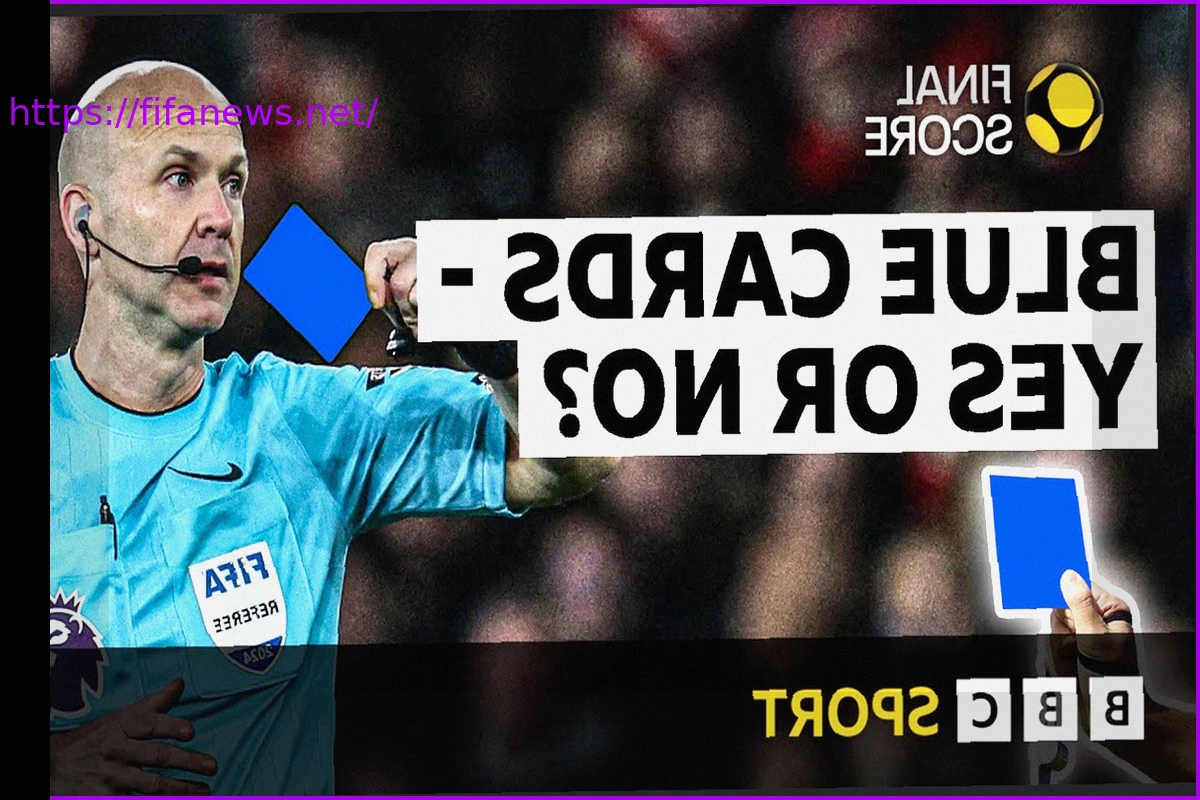
A Revolutionary Concept for Football Officiating
Football, a sport known for its steadfast adherence to tradition, finds itself at a crossroads with the emerging discussion around a “blue card.” This innovative proposal suggests an additional disciplinary tool for referees, positioned between the existing yellow and red cards. It would enable officials to temporarily remove a player from the field—a concept familiar as a “sin bin” in rugby.
Should this rule be adopted by the Premier League, it would mark one of the most significant alterations to the sport’s regulations in decades. The central question remains: would it genuinely enhance the game, or merely introduce unnecessary complexity?
Understanding the Blue Card’s Function
Conceptually, the blue card is designed to bridge the gap between a caution (yellow card) and a permanent dismissal (red card). Instead of a simple warning or an outright sending off, a player would face a temporary removal from play, typically for 10 minutes, for infractions such as overt dissent, cynical fouls designed to break up play, or deliberately stopping a promising attacking move.
This intermediate punishment aims to address a persistent challenge in football: certain fouls are too egregious for a yellow card but not severe enough to warrant a red. The blue card offers a flexible solution, providing referees with more options to manage game situations effectively.
However, integrating a third disciplinary card would undoubtedly reshape the tactical and emotional dynamics of matches.
The Arguments in Favor of Sin Bins
Advocates for the blue card system believe it could significantly improve player discipline and foster fairer play. A common frustration in contemporary football is the prevalence of persistent dissent—players confronting referees, disputing decisions, and attempting to sway outcomes.
A temporary dismissal could serve as a powerful deterrent. Losing a player, even for a brief period, would compel teams to reconsider such behavior. It would also bolster referees’ authority, furnishing them with a clearer means to control games without resorting to the extreme measure of a red card.
Another key benefit lies in addressing “professional fouls.” Currently, players might deliberately commit a yellow-card offense to halt a dangerous counterattack, accepting the relatively minor punishment. A sin bin would make such tactical decisions far riskier, potentially restoring a better balance between offensive and defensive strategies.
From a fan’s perspective, temporary expulsions could inject more drama into matches. A team playing with 10 men for a short duration inherently creates tension, akin to a power play in ice hockey or other sports. This could lead to more dynamic and unpredictable contests.
Tactical Repercussions
The introduction of the blue card would have a profound impact on team tactics. Managers would need to strategize for periods of numerical disadvantage, requiring on-the-fly adjustments to formations and game plans.
For instance, a team facing a sin bin might adopt a more defensive posture, aiming to weather the storm until their player returns. Conversely, opponents could capitalize on the opportunity, pressing higher and exploiting the increased space.
Squad depth and player versatility would become even more paramount. Players capable of seamlessly transitioning between different roles would be invaluable in managing these temporary disruptions.
Nonetheless, this added tactical complexity might also be viewed as a drawback for a sport often celebrated for its inherent simplicity.
The Counterarguments
Critics of the blue card argue that football risks diluting its unique identity by adopting elements from other sports. The existing system—yellow for caution, red for expulsion—is lauded for its universal accessibility and clarity.
Introducing an additional layer of punishment could sow confusion among players, spectators, and even officials. Inevitable questions would arise: precisely which offenses warrant a blue card? How consistently would referees apply it? Could it inadvertently lead to even greater controversy rather than less?
Concerns also exist regarding the natural flow of the game. Football is distinct for its continuous play, and frequent interruptions or stoppages for sin bins could disrupt its characteristic rhythm.
Furthermore, the issue of subjectivity is ever-present. Refereeing decisions are already under intense scrutiny, particularly with the integration of VAR. A blue card would add another layer of discretionary judgment, potentially escalating debates instead of mitigating them.
Player and Fan Perspectives
For players, a blue card would necessitate a significant shift in mindset. Discipline and emotional regulation would become even more critical, as minor errors in judgment could lead to a temporary dismissal at a crucial moment.
Fans, meanwhile, are likely to be divided. Some would embrace the enhanced fairness and dramatic tension, while others might perceive it as an unwelcome complication. The Premier League, celebrated for its relentless intensity and speed, could feel remarkably different with players regularly entering and exiting the pitch.
There’s also the challenge of maintaining consistency across different competitions. If the Premier League were to adopt blue cards while other major leagues did not, it could create considerable confusion, especially in international club and national team tournaments.
A Bold Step or a Step Too Far?
Ultimately, the concept of a blue card revolves around finding an optimal balance—a middle ground between leniency and severity in disciplinary actions. Theoretically, it presents a viable solution to long-standing issues in football, from player dissent to calculated tactical fouls.
However, football’s enduring appeal has often stemmed from its inherent simplicity. Any rule change of this magnitude demands meticulous consideration, as it carries the risk of fundamentally altering the very essence of the beautiful game.
Concluding Thoughts
The potential introduction of a blue card in the Premier League would undoubtedly ignite widespread debate, yet it simultaneously offers an opportunity for the sport to modernize. Whether it proves to be a valuable addition or an unnecessary complication will depend heavily on its implementation—and the collective willingness of players, referees, and fans to embrace such a significant change.
For now, the discussion continues. But one thing is unequivocally clear: even the suggestion of a blue card underscores that football, despite its rich traditions, is persistently evolving.